
Step-By Step Dance Ministry

The Story

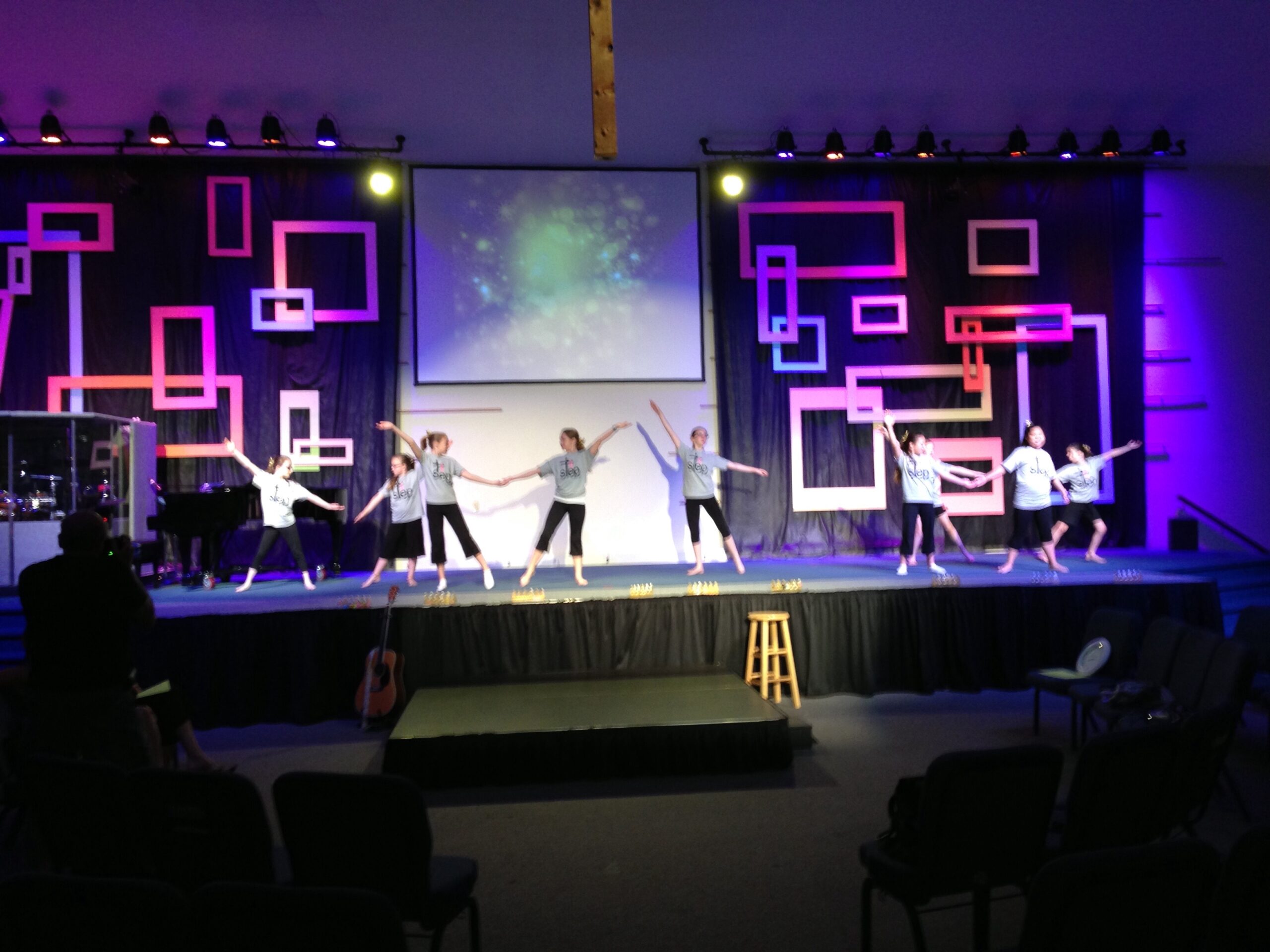
Two sisters stood before me in my office at church. These two had grown up in dance studios, and their dream was to begin a dance ministry at our church. Their pitch perfectly aligned with my philosophy of worship ministry: find as many ways as possible to use as many of the arts in worship. There are dozens of dance studios in our area, each of them churning out young dancers who perform in their recitals a couple times a year. Why not offer these young dancers an opportunity to direct their enjoyment of dance to serve the church?

The sisters recruited three other leaders, and we promoted this new ministry in the church for several weeks. At their first meeting they had about a dozen young dancers between grades 1-8 in the church foyer after church. Each rehearsal began with lunch and a devotion. After about 2 months they were ready to dance for the Lord on a Sunday morning. We pushed the band off to the side to allow space and let them go. I honestly do not remember the song they danced to, but I do remember the tears in my eyes watching these excited young ladies experience the joy of using their talents to serve their church. A whole new world was opened up to them. I was so moved I could barely speak as we all met to pray before the first service. 

The response was almost unanimously positive. The parents were thrilled to see their children learn what it means to participate in church, and not just attend Sunday School. The congregation appreciated this new form of art added to our services. Only one person pushed back, saying they “did not get” how this experience enhanced our worship. It only proved the diversity of opinions in the church, not an entirely bad thing I guess.
The Moral

Too often worship leaders are just song leaders. They only see music as the art form approved for worship. My philosophy (thanks to my early exposure to Willow Creek Church outside of Chicago) is to look for ways to bring as many artists into the worship service as possible. Musicians, singers, and sound techs are not the only people with artistic abilities to participate. Future stories will tell about adding middle school and high school worship teams, visual artists, poets, and Scripture readers to our worship. The younger the better. At an early age we can find ways to incorporate children into Sunday worship. While Sunday School is great for learning and forming friendships, using their talents to serve the church can build a bond that lasts past their school-age years. 

The other moral is that you can’t please everybody. Some in our congregations just like to sing and hear a sermon. That’s it. No frilly stuff like dancers or poets. While I attempted to explain why we had young dancers in our worship service, it was clear I was not going to change their mind, and that’s OK. We’re all different. 

The moral is to do what you believe God is directing you to do. (That’s not to discount legitimate pushback from your pastor or elders. Not every idea is a good idea.) For me, God led those two young ladies into my office with a vision to help children learn to love Jesus by dancing. When it came to fruition the whole church was better for it. 

Worship is not just music

I recently taught a breakout at the Cedarville Worship 4:24 conference on the “history of Christian Worship.” I traced developments in worship and eucharistic practices for 2000 years (in 50 minutes!) One participant left a comment online, “the topic itself was misleading. He didn’t really talk about the worship MUSIC of the church”

This is the first time I was confronted by the idea that for many people “worship” is synonymous with “worship music.” I’m here to say that worship is more than just music. Worship (as I define it as the corporate worship experience) encompasses everything from the opening call-to-worship to the final benediction. We worship when we read and hear Scripture, we worship when we hear God’s words in the sermon, we worship as we eat bread and drink wine/juice, we worship when we pray. We worship when we place our offering in the plate. And yes, we worship when we sing.

We worship as part of a community, and not just a gathering of individuals. We worship when we serve in that community. We worship as ushers, as Sunday school teachers, as musicians and singers, as sound techs and slide operators. We worship as we place ourselves in an accountability relationship with our church.

We don’t have “worship and then a sermon.” It’s all part of being part of the divine-human dialogue of we call the worship gathering. Be sure to gather with your church this Sunday. And don’t just sing. Worship with all your heart and soul and mind and strength.

Pagan roots of Christmas and Easter(?)

It began with a simple Facebook post from a friend who, after taking down Christmas decorations on Dec. 27, asked when others dismantled their decorations. Some had already taken theirs down while others, wanting to preserve some Christmas cheer at the end of a dreary year, wanted to keep them up longer. A few mentioned the traditional season of Christmas which lasts for 12 days, ending on January 5. They would undecorate after Christmas was over on January 6.

In reply to my comment about these 12 days of Christmas, one friend-of-a-friend brought up the topic of whether I would agree that Christmas and Easter had their roots in historical pagan celebrations. My short answer was “No to Easter, maybe to Christmas.” The answer required a lot more space than FB etiquette called for, so here goes . . . 

Our celebration of Easter Sunday (or more properly Pasca or Resurrection Sunday) flowed out of the Jewish celebrations of Passover, the Feast of Unleavened Bread, and Pentecost (a 50 day observation following the Feast) which in the first century had already been celebrated for about 1300 years. We must realize that at the time of the exodus almost the entire world, except for this group of Hebrew slaves, was pagan. There were hundreds of gods and thousands of shrines and temples to these gods. Paganism was the culture of the day . . . the water they swam in. This was also true in the time of Jesus. Remembering that the first Christians were Jews, we can understand that Passover, the Feast, and Pentecost were part of their upbringing, their major holidays, like Christmas and New Year are to most of us. But for these early believers Passover took on new meaning as they celebrated the resurrection of the Messiah Jesus. In fact for the first 300 years of church history Pasca was not a day, it was a period of 50 days. Celebrating something as monumental as a risen Savior required more than a day . . . it required 7 whole weeks!

While there were almost certainly pagan celebrations of springtime in those days, the true roots of our Pasca/Easter holidays flow out of the Jewish holidays which had already been practiced for over 1000 years.

Now Christmas, on the other hand, may have had its roots in the pagan festivals surrounding the winter solstice. There are 2 main theories of how December 25 came to be the Festival of the Nativity.

1. The Romans observed Saturnalia and the birthday of Mithra, the god of the sun, during this time of year. In the 4th century Christian leaders, seeing hordes of pagans entering the church, began adopting the festival of Saturnalia, saying that its final day, December 25, was Jesus’ birthday. The hope was that a pagan holiday would be transformed into a Christian celebration. Unfortunately the result was that many of these “converts” continued in their pagan practices, and Christmas was a raucous season of revelry and debauchery.

The problems with this theory are twofold- no early Christian writers refer to changing the Christian calendar in this way, and it would be unlikely, during a period when Christians were martyred for standing against the pagan culture, that leaders would deliberately adopt a pagan holiday as Jesus’ birthday. 

2. The second theory of the roots of Christmas has to do with calculating the date of Jesus’ death. Early Christian Fathers believed that a perfect life would begin and end on the same day. In the year 200 Tertullian calculated that Jesus died on March 25 on the Roman (solar) calendar. Therefore the perfect Savior was also conceived on March 25. Jesus was born a perfect 9 months later on December 25. Jesus was conceived and crucified on the same day of the year. This theory was affirmed by Augustine around the year 400.

So now you see why I replied as I did to the query of the friend-of-a-friend. Our Easter/Pasca celebration had its roots in Jewish tradition, and Christmas perhaps had some tradition in pagan holidays. Either way, for followers of Jesus there is nothing pagan of these sacred days when we celebrate the two most significant days in human history.